
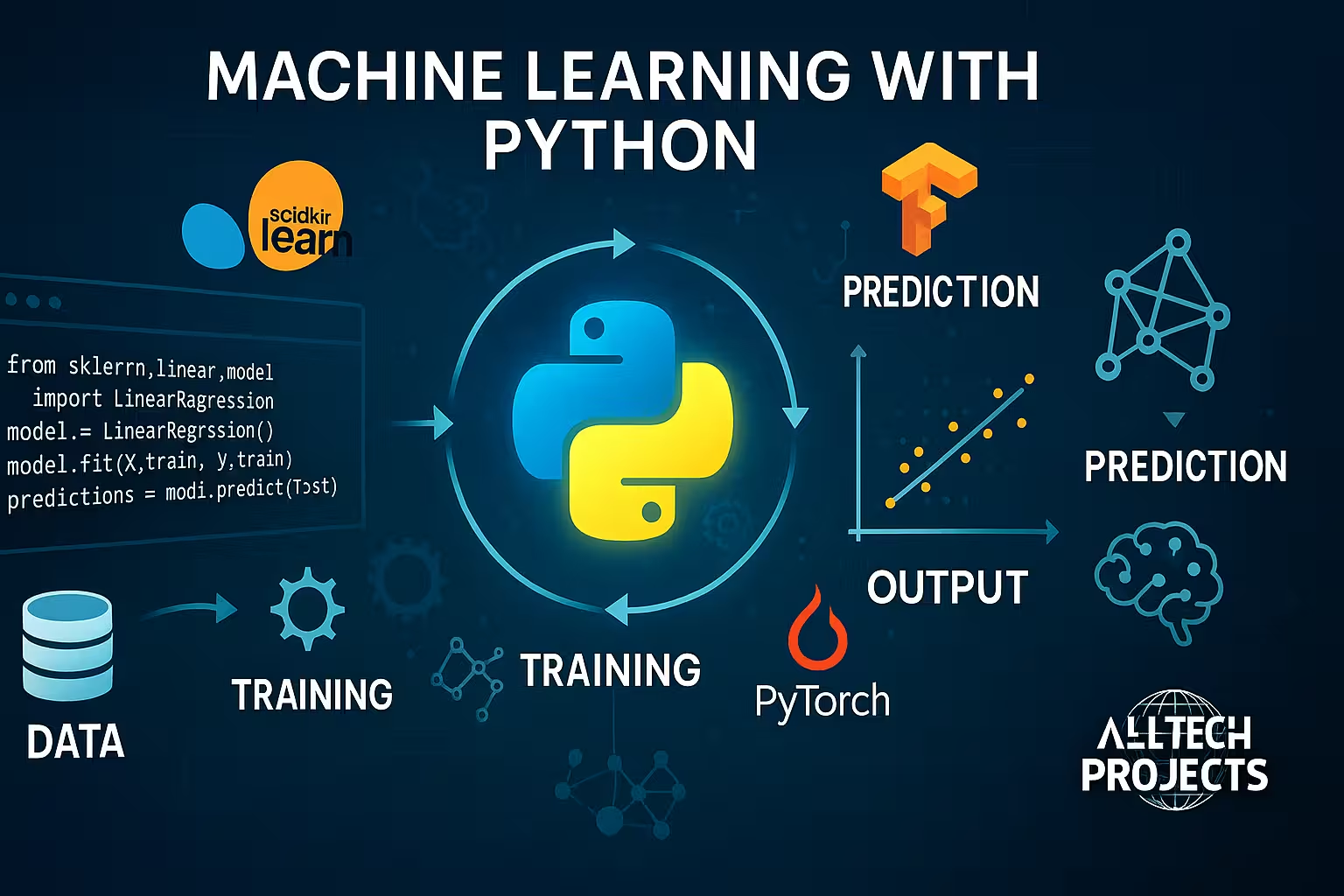
Machine Learning (ML) is a subfield of artificial intelligence that enables computers to learn from data and make predictions or decisions without being explicitly programmed. It is at the heart of many modern technologies such as recommendation systems, autonomous vehicles, spam filters, and financial forecasting. Python’s rich ecosystem of libraries and frameworks makes it the most popular language for implementing machine learning models efficiently and effectively.
In this chapter, we will explore:
- What is machine learning?
- Types of machine learning
- Steps in a machine learning project
- Python libraries for machine learning
- Building ML models with scikit-learn
- Model evaluation and tuning
- Real-world use cases and projects
Table of Contents
1. What is Machine Learning?
Machine Learning is a method of teaching computers to learn patterns from data and make decisions based on that knowledge. Unlike traditional programming where rules are hard-coded, ML systems automatically discover rules from the data.
Key Concepts:
- Dataset: A collection of data used to train and test models.
- Features: Input variables (independent variables).
- Labels: Target variable (dependent variable).
- Model: A mathematical representation learned from data.
2. Types of Machine Learning
2.1 Supervised Learning
- Learns from labeled data
- Predicts a target variable
- Examples: Linear Regression, Decision Trees, SVM
2.2 Unsupervised Learning
- Learns from unlabeled data
- Discovers hidden patterns or groupings
- Examples: Clustering, PCA, Association Rules
2.3 Reinforcement Learning (Basic Intro)
- Agent learns by interacting with an environment
- Rewards and penalties guide learning
- Used in games, robotics, real-time decisions
3. Machine Learning Workflow
- Define the problem
- Collect and preprocess data
- Split into training and testing sets
- Select an algorithm
- Train the model
- Evaluate the model
- Tune hyperparameters
- Deploy the model
4. Python Libraries for Machine Learning
Python provides robust and scalable tools for ML:
- NumPy and pandas – for data manipulation
- Matplotlib and Seaborn – for data visualization
- scikit-learn – for modeling
- XGBoost/LightGBM – for advanced modeling
- TensorFlow/Keras/PyTorch – for deep learning
5. Getting Started with scikit-learn
5.1 Installation
pip install scikit-learn
5.2 Loading Datasets
from sklearn.datasets import load_iris

data = load_iris()
X = data.data
y = data.target
Code language: JavaScript (javascript)
5.3 Splitting the Data
from sklearn.model_selection import train_test_split

X_train, X_test, y_train, y_test = train_test_split(X, y, test_size=0.2, random_state=42)
Code language: JavaScript (javascript)
6. Supervised Learning Models
6.1 Linear Regression
from sklearn.linear_model import LinearRegression

model = LinearRegression()
model.fit(X_train, y_train)
print(model.score(X_test, y_test))
Code language: JavaScript (javascript)
6.2 Logistic Regression (for classification)
from sklearn.linear_model import LogisticRegression

clf = LogisticRegression()
clf.fit(X_train, y_train)
preds = clf.predict(X_test)
Code language: JavaScript (javascript)
6.3 Decision Trees
from sklearn.tree import DecisionTreeClassifier

clf = DecisionTreeClassifier(max_depth=3)
clf.fit(X_train, y_train)
Code language: JavaScript (javascript)
6.4 Random Forests
from sklearn.ensemble import RandomForestClassifier

rf = RandomForestClassifier(n_estimators=100)
rf.fit(X_train, y_train)
Code language: JavaScript (javascript)
7. Unsupervised Learning Models
7.1 KMeans Clustering
from sklearn.cluster import KMeans

kmeans = KMeans(n_clusters=3)
kmeans.fit(X)
print(kmeans.labels_)
Code language: JavaScript (javascript)
7.2 Principal Component Analysis (PCA)
from sklearn.decomposition import PCA

pca = PCA(n_components=2)
X_pca = pca.fit_transform(X)
Code language: JavaScript (javascript)
8. Model Evaluation Techniques
8.1 Classification Metrics
from sklearn.metrics import accuracy_score, classification_report

print(accuracy_score(y_test, preds))
print(classification_report(y_test, preds))
Code language: JavaScript (javascript)
8.2 Confusion Matrix
from sklearn.metrics import confusion_matrix
import seaborn as sns

sns.heatmap(confusion_matrix(y_test, preds), annot=True)
Code language: JavaScript (javascript)
8.3 Regression Metrics
from sklearn.metrics import mean_squared_error, r2_score

print(mean_squared_error(y_test, model.predict(X_test)))
print(r2_score(y_test, model.predict(X_test)))
Code language: CSS (css)
9. Hyperparameter Tuning
9.1 Grid Search
from sklearn.model_selection import GridSearchCV

param_grid = {'max_depth': [3, 5, 10]}
gs = GridSearchCV(DecisionTreeClassifier(), param_grid, cv=5)
gs.fit(X_train, y_train)
print(gs.best_params_)
Code language: JavaScript (javascript)
9.2 Cross Validation
from sklearn.model_selection import cross_val_score

scores = cross_val_score(rf, X, y, cv=5)
print(scores.mean())
Code language: JavaScript (javascript)
10. Real-World ML Project: Predicting House Prices
Steps:
- Load dataset (e.g., Boston housing)
- Handle missing data
- Feature engineering
- Train/test split
- Train a regression model (e.g., Random Forest)
- Evaluate using RMSE, MAE
- Visualize predictions vs actuals
11. Best Practices
- Understand the problem before modeling
- Clean and preprocess data carefully
- Use proper validation techniques
- Avoid overfitting with regularization or ensemble models
- Monitor model drift over time in production
- Document and version your models and data
12. Summary
Machine Learning in Python is accessible, powerful, and scalable. With libraries like scikit-learn, you can quickly build, evaluate, and deploy models for a wide range of problems. Whether you’re classifying images, predicting trends, or clustering users, Python provides all the tools you need.
In this chapter, you learned:
- The fundamentals of machine learning
- Supervised vs unsupervised learning
- Common ML models with code examples
- Evaluation and tuning techniques
- How to approach a real-world ML project
✅ Next Chapter: Deep Learning with Python – Explore neural networks and modern AI using TensorFlow and PyTorch.